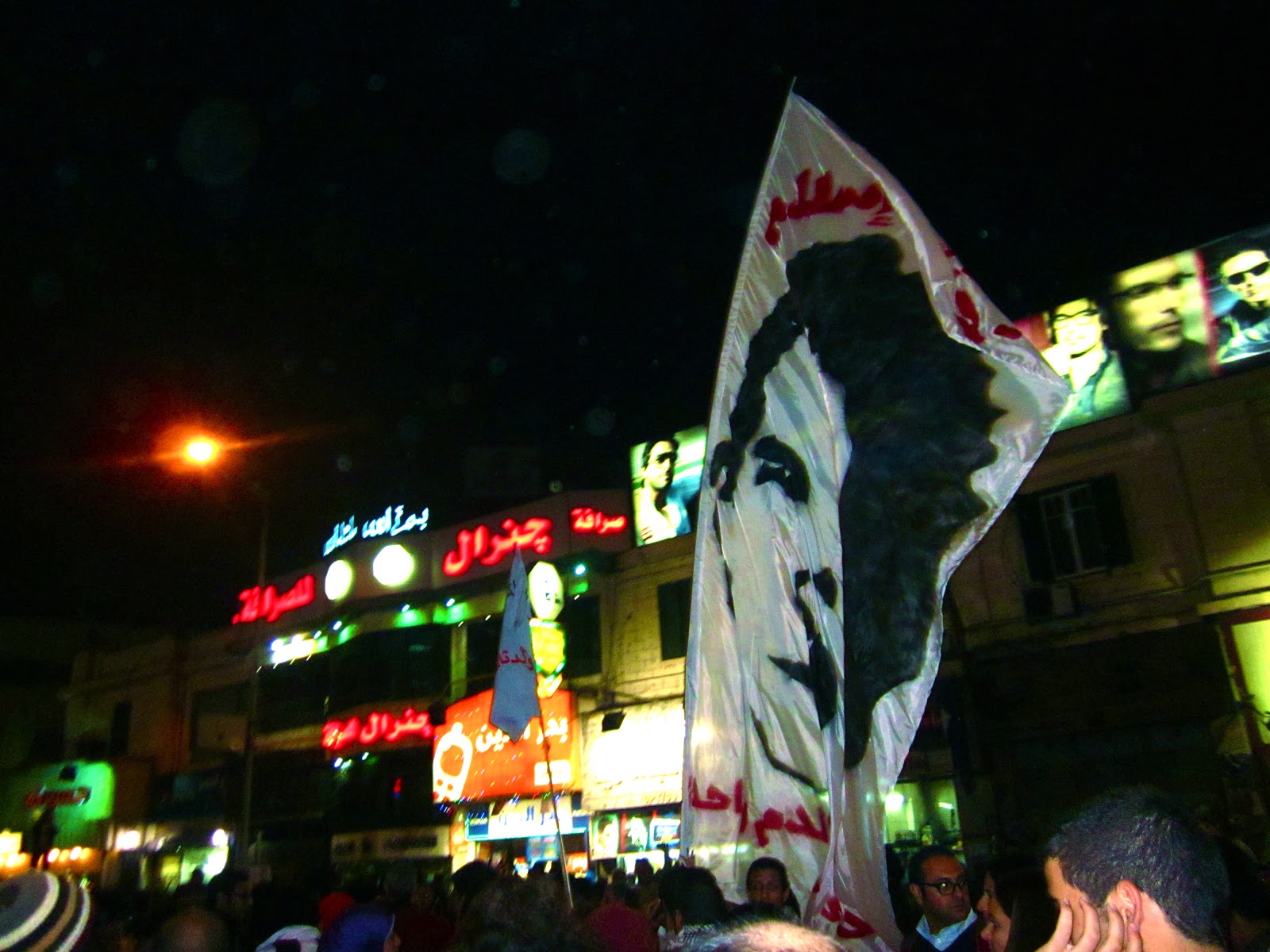
Thursday, February 21, 2013

How a Coptic Monk Got My Number and Other Tales

Hey guys, I'm back at last. The last few weeks have been busy for me personally but calm politically -- contrary to what one might have expected on January 25. But that seems to be how things work here: unrest waxes and wanes. One moment it seems that the country is truly in crisis and stability nowhere in sight, and then one morning after a series of demonstrations, I wake up to find the newscasters reporting on something else, something unrelated. It has become a habit to double check on Tuesday and Friday afternoons (the main days for protests) if anything is "going on" downtown or in Heliopolis, if I plan to go to either of those places. But by the start of the week, little memory of that specific demonstration lingers. However, a new player has emerged since January 25 -- the Black Bloc. No one seems quite sure of who they are, or whether they really exist in any organized way. We first heard of them on the anniversary: young guys in black ski masks calling to avenge the martyrs of the revolution. Each of two Facebook pages has 50,000 likes, but not much articulation of what the group stands for. The downfall of the Ikhwan, certainly. Anarchy, apparently. But are they a force for justice, a useful but potentially dangerous faction, or a destabilizing para-militia? "If I step forward, follow me. If I stop, push me. If I delay, then I am a traitor and so kill me." And then in English: "Get ready for Hell. Chaos against injustice." And another slogan: "When injustice because law, rebellion becomes duty." When I initially started reading articles about the Black Bloc, it was said that they did not prefer armed resistance, but rather disruptive acts (like blocking the metro tunnels), throwing rocks, and tossing the police's tear gas canisters back at them. Other times I've heard that they were, in fact, carrying weapons during the most recent metro blockage last week or so. Meanwhile, in Tahrir Square itself, the tents have returned for an ongoing sit-in. The colorful banners, speakers' platforms, political litter, and some barbed wire remain, but I've had no problem passing through. The most notable new mural I pass these days on my way to class at AUC's translation lab on Mohamed Mahmoud St. is one that pictures two policemen kissing. Originally, it read: All cops are gay. Soon afterward, however, another anonymous artist painted over the text and rewrote a new slogan: Homophobia is not revolutionary.


This was the backdrop against which my dad's recent trip to visit me took place. He didn't want to redo the Pyramids (phew!) and was more interested in getting a taste of my daily life (with a side of heavy smog). I had a lot of fun introducing him to my neighborhood buddies like Noss the Juice Man, who introduced him to the other employees as "Abu Chloe" and "'Am (Uncle) Fergus". We embarked on a number of adventures, including a fruitless search for Cairo's last stamp collecters' shop and a nostalgically rousing concert of golden age Egyptian music once sung by the likes of Umm Kolthoum. This latter was held at the Arab Music Institute, a hidden nugget of Cairo's past tucked in among the grayed-out facades of Downtown. Inside, everything is impeccably painted -- in golds, greens, reds -- and ushers in sharp burgundy suits are on duty to guide you to your plush wooden seats. It was originally founded, already in 1921, as a monument, a memorial dedicated to the preservation of "Oriental" music. It reopened under the Cairo Opera in 2001, evidently extremely well funded, after some period of disrepair. As the soloist crooned Umm Kolthoum's classic ballad "Enta 'Omry" (perhaps the most famous song ever written in Arabic), I thought of the crackly videos we'd watched in college Arabic classes. I hadn't imagined there was anywhere you could still get this kind of performance live. There is no doubt that everybody in Egypt still loves Umm Kolsoum and the composer Mohamed Abdel Wahhab, and sometimes one hears them in a taxi or a shop, but the days when the entire country would stop its work once a month to hear the diva's new hour-long masterpiece are long past. Yet in the time warp that is the Institute, a blind Azhari sheikh and a smattering of other rapt but aging fans still listen.

Another highlight of my dad's trip was our trip out to the Coptic monasteries of Wadi Natrun. We followed the Alexandria desert highway, which has sprouted villa compounds at a rapid pace, luring Cairenes away from the urban bustle. We were able to visit three of the four monasteries, all within a few kilometers of each other: Deir el Anba Beshoy, Deir el Souriany, and Deir el Baramouse. St. Beshoy, the local hero, apparently lived as a hermit in the 4th century in underground cells now under two of the churches. At Deir el Souriany, one can visit this cell and see the place where he tied his hair to a rope hanging from the ceiling so as to prevent himself from sleeping during prayer time. Most of the current structure is from the 11th century, and due to Berber attacks at regular intervals much was rebuilt. Today there are over 150 monks at each of the monasteries. At Anba Beshoy we joined a tour of Coptic pilgrims led by an enthusiastic Father Joachim, who treated us to Bible trivia as we walked. Others constantly stopped to ask him (and any of the other bushy-bearded brothers in black robes and embroidered skullcaps they could find) for a blessing. In one of the ancient monk's cells, we stopped and Joachim led the rest of the group in chanting - for me and my dad - a Biblical passage in the extinct Coptic language. I learned that it actually uses the Greek alphabet, with a handful of whimsically shaped additions to account for sounds only found in Coptic. While some of the other visitors went to visit the late Pope Shenouda III's tomb, we climbed to the roof for a panorama of the valley, an enclave of earthen domes topped with crosses.

 Roof of Deir El Anba Beshoy

Nearly next door was Souriany monastery, so named because Syrian monks inhabited the monastery for some stretch of the Middle Ages. As a memento of their stay, they left Syriac graffiti on the walls of the main church, as well as a number of frescoes in a completely different style from those done by the Egyptian Copts. Aside from the exquisite painting, Souriany was memorable for its many monk dummies set up across the grounds to demonstrate various monk activities: eating together, doing fieldwork, etc. While we were examining the frescoes, a live monk came up to us and offered to answer any questions. We sat down with Father Serapion in a corner of the chapel and he proceeded to detail his worries for us about the discrimination against Christians for government jobs and the number of Coptic girls being coopted into converting to Islam in the name of love. (It's possible to convert to Islam in Egypt but not to Christianity.) He was less terrified by the current regime than some other Christians I've spoken to, however: they all seemed to be bad for Christians, in his opinion, but they would hold firm in their beliefs. Fortunately, Father Serapion explained, the monasteries are thriving these days -- not as they once were, but they are recruiting enough youth to fill their ranks. I commented that that is certainly not the case in American monasteries and convents. Yes, he said kindly, because we are much more spiritual than you Americans. You have lost your religion; we have not. He noted sadly how many Coptic immigrants to America and Europe stopped practicing their religion. He turned to my dad, though, clearly thrilled by someone who had so many questions to be answered. But I can tell you are a very good Christian! he told him. We all just smiled and the Father asked for my phone number. One day I hope my English will be as good as your Arabic! he said.


One of the Syrian frescoes in Deir El Souriany

When we returned to the city, we balanced out our monastery visits with a day at some of the best mosques in Islamic Cairo -- Sultan Hassan, El Refa'i, and Ibn Tulun. I brought my dad next door to the Gayer-Anderson House, the English doctor's orientalist paradise I've surely written about before. As we moved through the museum, we encountered a pair of highly distressed Turks. One of them exploded in the face of our guide. I have been in your country for ten days (ten days!!), and I have traveled everywhere from Aswan to Alexandria... And you know what?! I have seen NOTHING about Cleopatra!!! NOTHING! Pure disgust. This was evidently the only reason Turkish Tourist came to Egypt, and he wanted his money back. Why he thought he would find the answer in the Gayer-Anderson house is anyone's guess. The National Museum? offered our guide, shrugging, but Turkish Tourist's fury would not be quelled. This man sought what many come to Egypt to find, his discouragement the realization of the absurdity of that quest once they're here. It's not, of course, that Ancient Egypt has disappeared (scroll down in this post), or that you won't be inundated with pharaonic knickknacks as soon as you step foot in the country. But there is what at times feels like a vast chasm between history - in all its ages - and the present here, and it can be disconcerting or disappointing for visitors.

A few days later we were off ourselves, though, to Luxor, an hour to the south by plane but a world away from Cairo's chaos and gray sprawl. The intentionally roundabout route we took to the airport brought us through the faceless, half-built megalopolis that Cairo becomes once one ventures beyond the inner neighborhoods and a few known outposts like Heliopolis and Maadi. Flying overpasses take you through eerily unlit seas of identical brick apartment buildings, most with rods jutting out from the roofs so that the buildings are never "finished" enough to incur taxes. These swaths of the city are entirely anonymous to me.

Luxor, on the other hand, is nothing if not manageable in size. Its problem is the dire state of the tourism economy. Empty horse-drawn carriages called caleches line the streets of the city, their drivers squatted nearby. Only once did I see anyone riding in one. Felucca boatmen stride beside you, promising: No hassle, no hassle. I'm just trying to make a living, you know? Many have certainly learned what appeals to tourists' sympathies. There is an undeniable awkwardness, and more foreigner's guilt, that comes about as a result of being among the few tourists (and only Americans) in a city whose entire livelihood has always been tourism. The Corniche is spotless, the sails of the feluccas flutter against the river, and the skies are fresh and bright, but the cruise boats are all tied up and the people's desperation is palpable.

How many camels for your daughter? might be an appropriate subtitle for this part of the post, as it was the most common refrain (aside, perhaps, from baksheesh?) we heard while in Luxor. This joke has, apparently, not gotten old yet. Our first pharaonic destination in the city was the Karnak Temple. It was close enough for us to walk from the center of Luxor. We spent the afternoon wandering through the site, playing Indiana Jones among rows of ram-headed sphinxes and pretending to translate hieroglyphics. Although I find it nearly impossible to identify with the Ancient Egyptians, walking through Karnak is pretty impressive. It was built over the course of approximately a thousand years, and while artistic taste doesn't seem to have changed much over that millennium, every pharaoh added his (or her! whoo Hatshepsut!) mark on some corner or other.


With Dad at Karnak 

The other important site on the East Bank of the Nile is the Luxor Temple itself, smaller than Karnak but especially spectacular by night. Part was turned into a church by early Christians and a mosque was built into another side once the Arab conquerors arrived a few centuries later. But the heart of the original temple still stands, many chambers replete with unreadable hieroglyphic inscriptions and monumental statues. Here we discovered more ram-headed sphinxes, which, it turns out, actually line a ceremonial route all the way to Karnak! Do the math and figure out how many sphinxes that is. We had tea in the nearby Winter Palace, the grandest of Luxor hotels, which played host to movie stars and vacationing princesses in a different era. Classical music wafted through the halls and a sign warned us to remember our formal wear if we wanted to dine as I sipped the thickest and richest karkadeh (hibiscus tea) I've ever tasted.


Luxor Temple by night 

We decided to devote our second day in Luxor to the West Bank, which is less developed than the East but home to every famous Egyptian tomb you've ever heard of and many you haven't. We decided to take the public ferry, and on the other side managed to shake off the hustlers to secure a couple of bikes for the day. We began riding out to the Valley of the Kings, inhaling deeply and basking in the warm sun. The first to greet us were the Colossi of Memnon, two gigantic statues that welcomed visitors to the land of the dead. The rocky hills ahead are thick with tombs, but took the long way around to reach the kings by bike. It is clear from the geography that the ancients hoped to outwit tomb robbers by cutting the most important tombs into a fairly narrow pass in the rock. (Still, the tomb robbers were smarter.) We chose to visit Ramses IV, VI, another Ramses, and Merenptah. The miraculously intact painting in some of the tombs - especially that of Ramses VI - was the most astonishing thing about them: parts look as if the paint went on last week, and yet the imagery is so distantly exotic. The golden sky goddess Nut stretches out, improbably, across the ceiling of much of the tomb shaft, encompassing the heavens beneath her limbs. In a couple of the tombs, ancient Coptic graffiti also suggests that visitors have been coming for quite some time.

(Sorry, photos were not permitted in the Valley of the Kings!)


Al haraka baraka, as we like to say -- "Movement is a blessing"

Skipping Tut because everything of his is in the Egyptian Museum these days, we made instead for some of the lords' tombs, tucked into the hills nearby. These are a bit more humanistic than the kings', a bit less shackled to artistic convention. Roy, for example, was a royal scribe rewarded for his labors with a rather unevenly cut but charming resting place. The ceilings are painted not with Nut but rather floral patterns that might possibly evoke Theban nobles' real home decor. Personalization is also more evident here than in the kings' tombs: special attention is paid to the tools of the trade, like the scribe's papyrus plants and pen holder. We spent that sunset, and the next, on the terrace of Marsam Hotel near the Colossi, overlooking green fields of wheat and skipping more cups of karkadeh.


 A fishing mural adorns one noble's tomb

On our final day, we at last made it to the Luxor Museum. It is actually much better organized than the Egyptian Museum here in Cairo, mostly because the artifacts are labeled. In addition to an excellent collection of Amenhotep busts and the like, the museum had on display a number of everyday objects (like cabinets, a bed, baskets) extracted from tombs looking like new, a scribe's writing materials, and an architect's scribbled plan sketched on the back of a piece of papyrus. These objects offer at least a glimpse of the humanity of that civilization, which can be so elusive in the temples and tombs themselves. From the Luxor Museum we went to the Mummification Museum, a room near the ferry dock that has laid out for your viewing pleasure specimens such as a mummified crocodile and a cat.

Off we were again to the West to reclaim our bikes and return to the funerary complexes. But first, I had caught wind (and seen a sign) that a village named New El Gourna was right around us. I had studied Gourna in my Art in the Modern Islamic World class back at Princeton because it was the chief project of architect Hassan Fathy and the practical application of his book Architecture for the Poor. Wikipedia says Fathy was "Egypt's best-known architect since Imhotep." That reeks of hyperbole, but may in fact be true. Fathy (1900-1989) wanted to reinvent Egyptian architecture, or rather create a modern Egyptian style that had a distinctly historical identity but was meant to be lived in and used by regular folks -- something that was not just mimicry of Mamluk mosques or Ottoman palaces. On the road from the ferry to the Colossi, we came across the first mudbrick house Fathy ever built in Gourna, which the son and granddaughter of the original owner have made into a small museum. The son has updated the house with basic modern amenities (electricity came to Gourna in the 1970s) and repaired the damage to the foundation and walls that comes from salt that has seeped up from the ground since the Aswan High Dam was built. Most of the village, though, fell into disrepair in the years after Fathy left it.  The owner of the museum house took us over to a couple of the handful of original Fathy houses that still remain. Wealthy Egyptians living abroad have hired this entrepreneurial guy to oversee the renovation of the historic homes. As we toured them, our guide pointed out the earthen domes used to create a feeling of natural air-conditioning. He sighed and explained that while Fathy intended his project for the poor, the poor had no interest in this "authentic" ambience: they dreamed of balconies and Corinthian frills. When wear and tear set in on their Hassan Fathy houses, they let them disintegrate and then built new, modern ones in their place. Now, he said, it was the rich who were charmed by the simplicity and historicity of Gourna.


The original Hassan Fathy house in New El Gourna

Despite the relative failure of Gourna itself, Fathy had a huge influence on Egyptian architecture (and even more broadly) in defining a style that was authentic but more or less suitable for modern life. Here's a mosaic mural of Gourna on the wall of the Fine Arts Faculty in Zamalek, done by students:


Before we left, we visited Fathy's village mosque, which is also crumbling at the base. The muezzin, Ahmed, explained that it is awaiting UNESCO funding. They hope it comes before the columns collapse.

Back on the trail we rode past alabaster workshops lying in wait for tour buses. Our favorite was the Opera Aida Company for Alabaster. I shuddered to remember the infamous jade factory affair of 2005, an unannounced detour from a group excursion to the Great Wall of China. But this time we were free to pass the factories by, and parked ourselves at Deir El Bahry, the Temple of Hatshepsut. Perched majestically against a craggy backdrop, the woman pharaoh's monument is approached by way of flights of sloping stairs. Throughout the temple, her face has been scratched out by her sourpuss stepson, the next pharaoh. But what remains is a pictorial representation of Hatshepsut's journey along the Red Sea coast to Somalia, known as the Land of Punt -- an evidently enchanting land of incense, ebony, and strange animal life.


Approaching Hatshepsut's Deir El Bahry

After dark that evening, we flew back to Cairo. We struck up a conversation with our taxi driver, Mansour, on the way to the Luxor airport. What do you think of the revolution? he asked bluntly. I told him I thought things had started well but were increasingly disappointing as time went on. Mansour agreed. He had voted for Abo El Fotoh in the first round, but had grown completely disgusted with the system. Luxor was in dire straits without tourism. It badly needed factories or some new way for people to work. Meanwhile, the police were imported from elsewhere -- mostly the same thugs as before the revolution. In Mansour's view, they had no respect for local ways of resolving conflict or for the dignity of the people themselves. Most importantly, he told us, A second revolution is coming. The first revolution was for the rich and the middle class. The second will be a revolution of the poor. They last two years had brought them only greater hopelessness. This time it will be violent. My dad asked: And where will you be when this happens? Mansour responded: I will stay home. I can't fix all the problems! He would continue studying tourism, graduate, and hope to find a job in a field whose value has disintegrated in the last two years. Meanwhile, he was proud to be middle class himself -- to share a taxi with his father and make enough that he didn't need to hustle or wheedle anyone for money. Mansour shook our hands grinning and sent us on our way.


Tuesday, January 29, 2013

Another January 25, Another Day of Rage

When boarding was announced for my Paris-Cairo flight last Thursday, one of the round, middle-aged ladies sitting behind me at the gate rose from her seat and proudly yelled out, "Ya habibti ya masr!" - Oh my beloved Egypt. A man several feet away shouted back: "Ahla balad fel donya!" - The most beautiful country in the world. Although I heard snatches of conversation among my fellow passengers that suggested they were touching on politics - a topic that rarely ends on a high note these days - it didn't seem to sour their boisterous mood.

Now, four days later, the death toll has topped 70, three large governorates are under 9pm curfew, and Morsi has imposed a State of Emergency on those particularly restive areas. This was a favorite Mubarak instrument in curtailing civil liberties and right to due process. In Cairo, daily life continues in its resilience to chaos, with shadows of the dark events occurring sometimes only blocks away passing over and becoming almost forgotten before they flicker by again. This morning, I took the metro to the refugee school as usual, pausing to change trains at Sadat, the metro station for Tahrir. A skinny young man in a ski mask stood on the platform gesturing at passing trains to shut their windows. As soon as I stepped out, my nose began to twitch from the tear gas that had seeped into the station from the square above. It struck me later how relatively unconcerned everyone seemed as we moved together through the station with our faces in our sleeves or, in some cases, surgical masks. Turmoil has established itself as relative normalcy.

The night I returned to Cairo, the eve of the anniversary, I ate dinner with friends at a seafood restaurant on an anchored Nile boat and chased it with ice cream from the peculiarly named (and more peculiarly themed) Wings in Flavours -- a restaurant whose main shtick is chicken wings dipped in bizarre flavors.    It was a calm evening, but the next day's importance hung in the air and I made plans to meet my Egyptian friends after Friday prayers. 

Just after noon on Jan. 25, Sarah and I arrived at Mostafa Mahmoud mosque in Mohandiseen. It was this bastion of upper middle class secularism that I had marched from back in November when liberals were raging against the Ikhwan constitution. The imam was giving his khotba, his sermon, which was broadcast via loudspeaker to the growing crowd milling around outside. "El adl asas el molk!" (Justice is the basis of rule) he proclaimed, quoting a prominent disciple of the Prophet. There was no doubt as to whom the imam was directing his message. He then quoted a hadith, a saying of Muhammad that appeared on many posters that day (alongside pictures of Morsi with his eyes poked out, lest anyone miss the connection): "When he speaks, he lies. When he makes a promise, he breaks it. When he reassures, he betrays." Morsi must listen to the opposition as much as to his own supporters, the imam warned. But a battle of Egyptians against Egyptians will do no one good. Lines of men had formed to pray outside, prostrating themselves in unified solemnity as if in preparation for just such a battle. The instant they finished, a shout went up from one of the crowd and the chanting began. Thousands seemed to materialize instantaneously and banners were unfurled. The far larger-than-life faces of prominent Egyptian women - from Umm Kolsoum to feminist champions of the last century like Hoda Shaarawi (known for unveiling) and Doria Shafik (the right to vote) - sailed above us. (I knew I had come to the right march!) Nearby two women carried a banner in English with the words: "Women choose their own fate... Not your Islamic state." A few feet away, however, a group held up a sign that read: "No to the American occupation." "Hey, if we turn you in as spies, we will be heroes!" joked our Egyptian friends. One sometimes gets too comfortable and forgets that liberalism, secular liberalism even, does not necessarily mean embrace of the United States.

A few posters below:
Doria Shafik presides over the march 

"No to the American occupation"; "(Morsi): Liar, hypocrite, insult to Islam, ..."; "Because of you, Egypt, we're going out in the streets."

In the crowd  

Another crowd scene 


Leading the chant


The unifying feature of the posters and the slogans chanted that day was their opposition to the Muslim Brotherhood. Its followers were known as kherfan - sheep - and the lines I'd learned in November ("Bee'a, bee'a, bee'a - al sawra ya Badie" - Sold, sold, sold the revolution, oh [MB Supreme Guide] Badie and "Down with the rule of the Supreme Guide", for example) were repeated. A new favorite was a chant that said something like "It's the 3rd Jan. 25 with no Ikhwani among us!", a reference to the Brotherhood's absence from Tahrir at the beginning of the revolution with the implication of its having stolen it later. 

It was nearly 70 degrees and sunny, lending the afternoon an aura of springlike optimism. Families marched along with their babies and old ladies leaned over their balconies holding up two fingers in solidarity and sometimes waving flags. Leading the chants in our area were two men about my own age who rode along on the roof rack of a car. At least once, a middle school student - a girl - was hoisted onto a friend's shoulders and led them herself. To one side of us passed Amr Hamzawy, a beloved member of parliament among liberals. I then felt a tap and saw another friend, Ahmed Farag, who was featured in this Egypt Independent article the day before. As we neared the Corniche, another one of the perhaps ten marches originating from different corners of the city streamed across the overpass above us. We looked up to see the marchers from working class Imbaba showering us with leaflets like confetti and cheering. Stopped for a while, I overheard an unveiled woman scolding another in full niqab. "El deen mosh keda!" she shouted. "El deen mosh mota'aseb!" ("Religion is not like that; religion is not fanatical!") The woman in niqab, apparently there alone, was a rare sight in that particular crowd. I couldn't hear her response to the other woman, but she carried a sign that read: "Tomorrow will be the Last Judgment unless you do not allow the Ikhwan." 

After a little over four hours of marching, we reached Qasr el Nil Bridge, gateway to Tahrir. Strangely, feluccas with their neon lights on and a scattering of passengers drifted by beneath us. What an odd time for a party boat, I kept thinking. The square itself, when we arrived around dusk, was pulsing with a celebratory energy. Rage blended with nostalgia. The biggest winners of the day were the street food vendors - popcorn, baked potatoes, even a shawarma guy who had rigged up his giant meat wheel in the back of a pickup truck and was enjoying steady business.

Revolutionary Shawarma


In truth, though, there was not much for us to do in the square and little room to move among the crowds. Plus, it was getting dark and I wasn't sure it would be safe much longer. I formed a kind of conga line with three male friends and we began to push through the pack. Suddenly, a stranger's hand found its way through our human sandwich, squeezing me from behind. My own hand shot back, seizing his wrist and twisting it. I couldn't see the face to whom it belonged but I held on as long as I could while shouting fuck you, fuck you, again and again. Nothing in Arabic came to mind. The men around us looked blank and confused, and then the hand slipped away. 

We got out as quickly as possible. Later I read about more than a dozen women who were seriously assaulted by mobs of men around the square that night. I am sharing this article not to scare anyone, although it is very scary, but to spread awareness of the horrors that can and do happen. Teams of volunteers are going out from the anti-harassment campaigns now to patrol -- but they need to travel in groups of 15 men in order to be any kind of match for the perpetrators of these disgusting crimes.

I made a beeline for the metro a few blocks away, at Naguib. I said goodbye to my friends and breathed a sigh of relief. Less than five minutes later, the metro stopped in the tunnel. The conductor's voice sounded. All I could make out from the crackle was motazahereen, demonstrators. The lights dimmed. The doors opened. The matrons in my car let loose apocalyptic screams. We were about two-thirds of the way between Naguib and Sadat stations, and Ultras had blocked off the tunnel. There was little to do but get off the train and begin walking back to the station from whence we came along the narrow concrete platform that ran alongside the track. It was both dingily eerie and comedic: some people were inexplicably pushing with full force in the opposite direction (that of the block), one lady was taking pictures and flashing us a thumbs up from inside the car, and the man in front of me on the platform found it an excellent time to repeatedly turn around to ask for my name, country of origin, phone number, whatever he could get.

 At this point, back where I started, I reconnected with Sarah and we found a taxi to take us home. Less than five minutes later, we were stuck again, this time on the massive 6 October Bridge that spans the breadth of the Nile. No traffic was passing. So we got out and walked across, a peculiarly serene experience amidst the mayhem. The lights of the Foreign Ministry building spelled out "25 Jan" in Arabic.

Back home at last, I scrubbed the soot of the metro tunnel off my hands and changed into a fancy dress and silver heels. I felt ridiculous prancing outside in that outfit given the circumstances. But I was on my way, quite improbably, to the wedding of a friend in Heliopolis. An hour and an extortionate sum later, I was at Dar al Hay'a al Handeseyya, the Engineering Authority Club. The zeffah, the entrance of the bride and groom to the boisterous tune of traditional squawky horns and drums, was just getting underway.  The hired dancers pushed me into the circle with the couple. The other friends of the groom and I then hurried into the banquet room, lining up to welcome the newlyweds to the tune of Chris Brown's "Forever".  The room glittered with tulle, mirrors, cascades of light, and at least one disco ball. In the center was a dance floor and a platform with a loveseat draped in gold for the bride and groom. Three giant screens adorned the walls, channeling the constant live feed of a ubiquitous videographer a few yards away who captured every smile, shift, and nose twitch of the bride and groom.

Things began in earnest with a slow dance for the couple, accompanied by a smoke machine. The guests - a mix of city people and village people, of Egyptians and English (the bride's family), of women in short skirts and flowing hair and women in full niqab -- looked on together. Then the dance groups kicked in, and they continued all night long, some sporting galabiyyas, tambourines, and turbans, others tight boy band button-downs. They had us guests practically doing cartwheels around the room all night in a dizzying exercise of joie de vivre.


The bride and groom appear before the guests 


Wedding dancers

Clowns and dervishes

Meanwhile, the videographer kept us updated on the couple's activities up front. They fed each other red punch from each other's cups, and then a family member (of the groom I suppose) ceremonially presented the bride with what is essentially a dowry. A case was opened to reveal an array of gold, silver, and diamond jewelry for the bride. Although the cake was cut and the rings exchanged midway through the night, it was nearly midnight when the dinner buffet was unveiled. (If they did that first, a friend explained, everyone would just eat and leave!) Grumblings were heard about the village relatives making off with doggie bags of meatballs and sliced chicken.

I figured after the food that things were wrapping up. But then the rainbow clowns showed up on stilts, and with them the whirling dervishes with light-up skirts. Certainly this was a high note to end on.

There had been no talk of politics during the wedding, at least not within earshot. Around 2am, my friend Ryme and I got in a car with some of her friends to head home. We arrived quickly at the Corniche, but found the bridges closed. The driver rolled down his window to ask advice and tear gas filled the car. Volunteers - from the area I suppose - stood on the street waving traffic back. Someone handed us cotton balls doused in vinegar to hold to our noses. The street to our right was littered with debris and burning tires that flickered in an uncharacteristic darkness. Some people seemed to be just standing at the waterfront, as if nothing unusual was going on. But we could also see groups of young men, shabab, clustered along the road, agitated but uninterested in us. We turned around and drove back in the direction from which we'd come. The day tapered to an end in an impromptu slumber party at the groom's cousin's apartment, a calm end to a day of extremes.

The next morning, we rode home in our wedding clothes. The taxi driver reminded us, though we knew already, that the Port Saeed decision had come out while we slept. Twenty-one soccer fans from the canal city sentenced to death for their role in the post-game riots that led to more than 70 dead last February. If they were found innocent, Cairo ultras said they'd seek deadly revenge, and vice versa. The Port Saeed people feel victimized. Families and friends of the sentenced stormed the jail almost immediately, killing more people in an attempt to free those in prison, who were to be killed for their role in killing others. Bloodshed for bloodshed.

Now it's late Tuesday night, and the curfew is broken in the governorates, Port Saeed has declared itself an independent nation with a new flag, and here in Cairo clashes continue sporadically on Qasr el Nil Bridge about 2km away. It's hard to tell who is even fighting anymore. Last night the luxury Semiramis Hotel was looted by thugs, and for a brief moment protesters stopped fighting the police to turn in the thugs to them. The chief of staff of the army warned this afternoon that the country could collapse if things continue in this vein. But as we wait to see what happens, and hope to God that he's wrong, we go to the movies, we eat out, we go to the supermarket, and we go to class. We even went to the BMW showroom and sat in a few dream cars - a suggestion of Seeko's. Please, let's talk about anything else.


Sunday, January 13, 2013

A Season Ends


Whenever I am in an airport, I find myself scanning the departures board and imagining that I am bound for Tripoli or Kuala Lumpur or Ouagadougou – whatever place is the most far-flung. Today, sitting in Charles de Gaulle airport in Paris and counting the hours until I am back in the United States for Christmas, there is no destination that sounds more enticing than home.

I spent a week in Paris, convalescing a little and revisiting the places that meant something to me as a study abroad student my junior year of college. As I’ve written before, I had fallen into frequent comparisons between my experience living in Cairo and in Paris – however unfair or unrealistic – during my low months of September and October. It is true that I was extraordinarily happy in Paris. But this week has reminded me that a good part of that was due to the confluence of many good things at the right time: the group of friends I studied with, who are now scattered around the world, the lack of responsibilities, being a college student, etc. It will always be a wonderful place to return on vacation, but Paris is no more my home than Cairo is, and I won’t ever be able to recreate that spring, even there.

Passing through Paris did, however, bring me a sense of contentment: eating ham, seeing people read books on the metro, an abundance of small dogs – as well as the bigger things, like reuniting with my host family in their comfortingly familiar apartment. On my last night in the city, I was waiting on the platform for the 10 train to Gare d’Austerlitz. When it pulled up, the driver, who was wearing a long Santa Claus beard, waved to catch my eye. I saw then that he had posted a sign in the window that read: “Vous êtes sur la bonne voie.” A good omen, I felt.

The day I flew from Cairo to Paris, one week earlier, I awoke before sunrise to catch a taxi to the airport. It was the day of the first round vote on the new Egyptian constitution. The driver, white-bearded and wearing a gray galabeyya and cap, did not discuss it. He hoisted our suitcases onto the roof, a weight that caused the car to sputter and groan, barely lurching forward in the predawn darkness. We drove in silence across Qasr el-Nil Bridge towards Tahrir. There would be activity there later in the day because of the referendum, but we had caught the heart of Cairo at a rare moment of stillness.

At the end of that same day, I was on a rooftop on Rue Saint-Jacques in Paris just after the rain, surrounded by the twinkling lights of the Eiffel Tower, the Pantheon, and, in the distance, Sacre Coeur.

As soon as I was gone from Cairo, it became very difficult to keep the pulse of events there. Since late November, it had been hard to know what would happen from one day to the next even while I sat in the midst of things. A week after I left, the second round of the constitutional referendum was held and the constitution passed with more than 60 percent of the vote. Morsi then signed it into law, and new parliamentary elections will supposedly occur within two months.

The Journalists' Syndicate 

The week before I left Cairo, though, people were unsure that the vote would go off smoothly, given the increasing polarization of potential voters. One day, I went to an open press conference at the Journalists’ Syndicate downtown, “Martyrs at Etehadeyya.” The syndicate was an imposing building filled with leather sofas a few decades old and clusters of men in suits surrounded by a perpetual cloud of smoke. The hall where the press conference was being held was full, though more people seemed to be loitering outside.

The journalists’ syndicate had organized the event to call attention to criminal misdeeds on the part of the Muslim Brotherhood and its hired thugs during the clashes at the palace that followed Morsi’s constitutional declaration. Even the moderator spoke with accusatory fire about what had transpired. The first to speak was the brother of a man killed in the clashes, apparently by accident as he made his way home from work. A young woman and a man, the leader of a socialist youth group, spoke of being restrained and tortured, and an old woman in the audience interjected to corroborate their account. A prolix ex-diplomat, apparently some kind of Mubarak-era dissident, then recounted how he was arrested and beaten by semi-official gangs of thugs during the demonstrations. A panel of wounded men then took the stand. The first introduced himself as “a secularist and an infidel”, acknowledging how rare it was to hear someone admit that in public. Indeed the man beside him, when it was his turn to speak, made sure to distinguish himself as a committed and god-fearing Muslim.

When I emerged from the official event inside, I realized that the real event was happening on the steps outside. An angry crowd of a few hundred had amassed and was chanting against Morsi and the constitution. A large banner strung across the front of the syndicate read: “Absolute power corrupts absolutely. The journalists reject the constitutional declaration and the constitution.” I lingered for a few minutes, listening to the now familiar slogans. In the crowd I recognized an elderly dissident poet, Zein Abdeen Fouad, whom I had seen perform in June with Baheya, a group that sings the leftist revolutionary songs of Sheikh Imam. Fouad wrote songs for Sheikh Imam (now deceased) in the 1960s and 1970s, during the last serious wave of liberal political activism in Egypt. Beyond the poetic realm, it’s rare these days to see comparisons between the current revolutionary generation and the previous one. Perhaps it has simply been too long, but today’s youth rarely seem to view themselves as continuing in an older liberal or leftist tradition.


"Absolute power corrupts absolutely: Journalists reject the constitutional declaration and the constitution." A sign at the unofficial rally outside the press conference. 


We read and dissected the constitution that same week in class. It is, on the whole, quite predictable. The preamble cites the slogans of the revolution, the role of youth in leading it, and the role of the security forces in supporting it. It announces the intention to build a “modern democratic state” based on a long list of principles, including popular sovereignty, personal and national dignity, freedom of thought and opinion, equality, rule of law, national unity, security, etc. Many of the articles that follow are very specific – outlining the role of Al-Azhar, for example, or the representation of tradesmen in their unions and syndicates. The vast majority is not controversial. Two points that are, however, deal with women and religious minorities. Concerning women, Article 10 says that “the family is the basis of society, religion, values, and patriotism…” and that it is the state’s duty to protect the family, and to anchor its moral values. Although later articles guarantee the home as a private space free from government interference, many feminists and liberals in general are, not surprisingly, alarmed at the ways in which Article 10 might be interpreted by a conservative regime – that is, whether it will allow the state to establish laws limiting women’s freedom outside the home. As for religion, the constitution defines Islam as the state religion and the basis of law but guarantees Muslims, Christians, and Jews (ahl al-kitab, or, “people of the book”) the right to practice freely. Despite explicit assurances of freedom of thought, those who fall outside the three main monotheistic religions, such as the Baha’i, are not guaranteed the right to practice. This seems to have drawn less attention than Article 10 within Egypt, but is concerning to those outside.

Thanksgiving

In the last month or so before I left Egypt, I began reevaluating my personal relationship with city and the society, which I think will always be characterized by conflicting emotions. My friendships with the other Americans deepened, as did my friendships with a core group of Egyptians. The week of Thanksgiving, a friend from Princeton also came to stay with me for a week. Showing a guest around caused me to see my life in Cairo a bit like a newcomer again, or at least to feel a sense of pride in how I’ve come to know many parts of it quite well. When my friend rushed to take pictures of things like the metro station or the donkey carts, I was reminded of how the exotic has in many cases become mundane. I felt contentment and confidence in my mental map of the city, my comfort level so far from home, my understanding of how to hop microbuses or navigate the alleys around Khan El-Khalili. It gave me the chance to step back and see how I had come to belong, in some way, to my neighborhood (albeit a rather gray and nondescript one), with the toothless doorman Ibrahim who greets me every morning with the nickname asaleyya (honey-like), or “Half”, the pint-sized juice man at City Drink, or the grinning, round-faced grandmother squatted with her tissue boxes outside the bakery next door.

Thanksgiving itself was one of the loveliest days I have had in Cairo. It was a day when many of my favorite parts of two cultures came together, with good friends and good food. I spent the morning with Krisia, my college friend, at Khan El-Khalili, where she wanted to buy souvenirs for her family. Both the skies and the streets were strangely clear, both rare conditions for this overcrowded and overpolluted city. We managed to find a place in the women’s section of El Hussein mosque, which lies at the entrance to the bazaar. I vividly the remember the first (and only other) time I set foot inside El Hussein, when I was 16 and visiting the interior of a mosque for the first time. Then, I had fussily arranged the pink and lime green scarf I had bought just for this occasion, worried that a wisp of hair might escape the side and terrified of walking in front of a prostrated worshiper, which we had been warned against. Six years later, I was the guide, leading my friend through the passage from which believers can view the supposed tomb of the Prophet Muhammad’s nephew.

Winding through the Khan, we at last emerged at Moezz St., the gem of Islamic Cairo. Moezz teems with the colors and smells of modern Cairene life, which seamlessly coexists there with restored Mamluk mosques and madrasas and Ottoman fountains and merchant homes. Motorbikes whizz through the crowds that stand ogling the ancient buildings, while craftsmen nearby patter away on their brass crescents (for topping off your local mosque) or on life-sized shisha pipes. The end of Moezz leads to the mosque of Hakim bi-Amr Illah, refurbished in the 1970s entirely in gleaming white marble. It was at this unusually serene spot where we were leapt upon by a gaggle of uniformed school girls, gleeful at their discovery of the exotic species of blue-eyed and fair-skinned female. After many photos, they convinced me to give them my Facebook page, and within a few hours I had friend requests from a dozen anonymous high school girls. All used bizarre pseudonyms and posted no photos of themselves, presumably to hide their accounts from concerned parents, though effectively making them entirely anonymous. (The sociology of Facebook in Egypt deserves its own post another time.) In a city accustomed to tourists for centuries, I always find it strange when I receive this reaction. But it is not uncommon.

Thanksgiving Day marched on, and by late afternoon we were feasting on a real whole turkey (catered from our favorite Syrian restaurant Dar Gdodna) at my friend Lindsey’s apartment. I had made cranberry sauce for the occasion, having acquired cranberries through friends from the embassy’s commissary. My friends similarly strove to recreate a real American Thanksgiving, producing apple and pumpkin pies, mashed potatoes, sweet potato balls, and green beans. This was the very moment when the Mohamed Mahmoud St. protests, later to blossom into the constitutional declaration protests, were erupting anew. Against this backdrop of mounting anxiety and insecurity, we all felt especially grateful for spending the day in safety with such wonderful friends. After the meal, while most napped, Kevin and Krisia and I made our way to a balady café elsewhere in Zamalek in an attempt to teach Krisia how to properly smoke a shisha (much to the amusement of the other patrons). Then we made a spontaneous decision to catch Cairokee band’s 10th anniversary concert at Sakiet El Sawy, the cultural center perched beneath the 15th of May Bridge, where the Nile laps at the sides of the hall. Cairokee, which sings Western-style rock in Arabic, reached the pinnacle of fame with its revolutionary song “The Voice of Freedom” (Sout el Horeya), whose music video was filmed in Tahrir during the 18 Days. Many of the band’s songs evoke the emotions of the revolution, and singing them together seemed to infuse the crowd with nostalgia for that time – as well as perhaps anticipation for the building conflict. Singing along with songs like “Wanted: A Leader” (Matlob Zaeem) and “Stand Your Ground” (Esbat Makanak), I, too, felt like I was recapturing some of the patriotic spirit that still lingered when I visited last January.

At Sakiet El Sawy, waiting for Cairokee to come on.  


Thanksgiving ended with a return to America, figuratively speaking. Some friends hosted a college-style “Drinksgiving” party, proudly featuring red solo cups and nostalgic games like Kings and beer pong. The day reminded me that I have been happiest in Cairo when I don’t try to hard to “go native”, as some expats seek to do, or, at the other end of the spectrum, to isolate myself in an enclave of other foreigners.

When friends visit Egypt, it's time to head to the Pyramids and, naturally, rent a camel. 

Ibn Tulun mosque from above, one of Cairo's finest sights.  

Ismailia

That same week, I took a bus with several friends to Ismailia on the west bank of the Suez Canal. Though a very pleasant small city, it is not much of a tourist destination these days. Built in the 1860s by Khedive Ismail, it is one of the three great Canal cities, along with Suez to the south and Port Said to the north. Because of the canal business, it was for a long time a leafy European enclave – though it was also the city where the Muslim Brotherhood was founded in 1928.  The center of the city was quiet, with an abundance of slightly overgrown parks that seemed out of place in Egypt. Certain blocks are still lined with neat green and white wooden-shuttered cottages that once belonged to British and French expatriates. 

We were the only visitors that day to the small, dusty museum, which was guarded by an identical trio of stout gray cats. The pharaonic statuettes and coins, the Neolithic jewelry and cabinet of garishly retouched mummy masks, bore yellowed labels typewritten in some other era. Emerging from the museum late in the afternoon, we went on foot to the Suez Canal. A colorful painted gate close to the water read: “The Suez Canal is the artery of goodness and the spring of prosperity.” A police officer stopped his car to offer his help, should we need any: it was not so busy a day in quiet Ismailia. At one point, the canal opens into Lake Timsah – a slightly swampy green landscape one rarely encounters in Egypt. Two old fishermen sat on the edge of the lake, but no fish came. At the narrower part of the canal, we stood for some time watching the car ferry cross back and forth from Sinai. A giant freighter chugged past, making the rowboats of the fisher boys casting their nets far below look like toys. Sinai, across the canal, was empty except for what appeared to be an enormous silver knife – a memorial, we discovered, to the 1973 War. On our walk back to the bus station at the end of the day, we saw something completely unlike anything we’d experienced in Cairo: scores and scores of men and women jogging along the waterfront. Tracksuits and Nikes of every color dotted the sidewalk, while more conservative women ran in loose coats and scarves. With fond feelings toward sleepy but sporty Ismailia, we returned to Cairo.

Cats reign supreme at the Ismailia Museum. 

Boys fishing on the Suez Canal.  


The artery of goodness and the spring of prosperity: Ismailia heartily welcomes us to the Suez Canal.

Academics

My fall classes were winding to a close. One weekend we were sent to the Fustat Traditional Crafts Center in the oldest part of Cairo, just outside the Coptic quarter and beside the mosque of Omar Ibn el Aas, Arab conqueror of Egypt. We found only one artisan, a friendly Ahmed, still at work, though it was only early afternoon. He walked us around the center, showing us the traditional crafts and Islamic patterns that it strives to keep alive.  There is wood furniture inlaid with mother-of-pearl, carved gypsum backed with colored glass to let the light shine through, quilts, brass work, and pottery. Ahmed is a potter, and so he brought us to the wheels and the kilns. I sat with him and a couple friends in the workshop where he and the other potters – mostly women – paint designs on their fired plates and vases. Most customers are foreigners, he explained; they are the ones willing to pay good money for well-made handicrafts done the traditional way. He and the other artisans search through books of Islamic art to find authentic designs. Ahmed, who is about 30, left for the day when we did, and we all rode the metro together from Mar Girgis. He explained then how he had begun college, but had visited the center, then new, with his father and decided to become a craftsman instead. His father, too, was an artist, he told us, and didn’t mind that his son had chosen such a career. His grandfather, he added, had been a secretary in the court of King Farouk. What did he do in 1952? I asked, referring to Nasser’s coup and the fall of the monarchy. Oh, it was time for him to retire, said Ahmed.

Ahmed shows us how it's done at the pottery painting workshop. 

Around the same time, I gave my final oral presentation in one of my classes on Heba Kotb, the first Islamic tele-sex therapist. Sometimes referred to as the “Dr. Ruth of the East”, she has hosted several television shows that focus on improving spousal relations and preparing clueless brides and grooms for marriage. Episodes concentrate on things like pre-wedding grooming, “women’s pleasure”, and what to do on a honeymoon. She takes questions on her website with frequent references to the proper Islamic point of view, and though women’s rights activists and liberals tend to laud her for educating a populace about topics rarely discussed in public, some of her more controversial “advice” has included offering cures for homosexuality. In a fairly typical question on her website, a man writes in panic that he’s unsure his girlfriend’s hymen is intact, as he is unsure where “this thing whose loss is the dearest of all she has” is located. In Kotb’s response, while offering some facts on the hymen and its importance, was sure to admonish the questioner for “un-Islamic intimacy” – where, after all, the third one present is Satan. He is there to sow strife and discord, and is the only one who profits in the end from such behavior. Kotb’s shows have met with great popularity, finally answering many of the questions girls (especially) are far too shy and ashamed to ask. (Still, she’s controversial, and many conservatives are very dismayed by these discussions, however much she may emphasize that she is speaking to married couples.) At the end of our class discussion on Kotb, our teacher – a fairly conservative woman in her sixties – brought up the double standard for men’s and women’s behavior before marriage. While the vast majority of parents and girls still place immense value on an intact hymen (and proof thereof), men are tacitly encouraged to have “experiences”, as they are referred to, before settling down. Mothers, said my teacher, a mother and grandmother herself, are often proud when their sons have premarital sexual relationships with girls, though those girls themselves are almost always branded as unmarriageable sluts (even by the same men). It’s worth noting that sexual mores vary somewhat across urban-rural, religious, and above all class divides, with upper classes tending, not surprisingly, to be somewhat more permissive; however, these observations are those of my urban, intellectual professor, not a country bumpkin.  


Farewell (for a while) 

The last week before I left Egypt for the holidays was filled with dinners out, potluck brunches (or, as they’re called here, “dish parties”), and frantic scurrying to buy Christmas gifts for everyone back home. CASA hosted a holiday brunch for us, on a day suddenly warm enough to walk all the way from my apartment in Dokki; the teachers sang the Arabic version of Jingle Bells by Fairuz – “Laylat Eid.” This day was emphatically an exception: yes, Egypt gets cold. It’s a cold that doesn’t last many months, but that cuts at your bones. Indoor heating is virtually unheard of (perhaps because Egyptian engineers are as much in denial about their country having a winter as we are?), so the inside is at least as cold, and usually colder, than the outside. People have coped with this by purchasing expansive fuzzy bunny suits and fleece pajama sets.

One night, Nada and Seeko took me and my roommate, Sarah, to dinner at the Shooting Club. I’ve mentioned Cairo’s social and sporting clubs, the safe havens of the moderately well connected and well-to-do on up. The Shooting Club is one of the oldest, a vast expanse of green lawns and blue pools fenced off from the general public between the urban neighborhoods of Dokki and Mohandiseen. After spaghetti and meatballs (fried chicken and spaghetti count as “club food”), we wandered over to the shooting range for which the club was named. Established by a royal decree from King Farouk in 1940, it now costs 150,000 LE to join (and there are, I have read, 60,000 members), but membership is passed down from generation to generation for a nominal yearly fee. Once you’re in, you’re in. The shooting range was dark for the night; the action had moved to the cafes, lounges, and minimall. So we combed it for brightly colored cartridges, as my friends said they had done as kids, pocketing them for souvenirs.

A day or so later, in a last-ditch attempt to find appropriate gifts, I found myself in the alleys behind Al Azhar, where butchers and bookbinders coexist in harmony.  My friend Robin and I had gone in search of the khayameyya – the tentmakers’ market. We discovered it tucked behind the crumbling edifices of Islamic Cairo, beyond a teeming slum contained just out of sight of the masses that come to bargain for belly dance costumes at Khan El Khalili. Another year, there might have been scores of tourists, of the more intrepid variety, who made it to the khayameyya. But in this post-revolutionary Egypt, we seemed to be the only ones. The craftsmen there still do their work by hand, though they’ve migrated from tents to wall tapestries, pillowcases, and tablecloths. I sat down for hibiscus tea with one vendor as he explained to me the intricacies of constructing a quality quilt, stitching designs from one piece of fabric instead of many. He was especially proud, though, that he had recently been to Michigan to exhibit his quilts (where they sold for many hundreds of dollars apiece). Though business had screeched to a halt in the Cairo market where these men have been for perhaps hundreds of years, foreign business (for those who could get there) was thriving.

After purchasing a quilt, I strolled over to El Hussein at the entrance of Khan El Khalili to wait for Nada. I sat and watched people moving through the plaza: tourists boarding their buses, salesmen of sphinx figurines hot on their trail, men with trays of bread stacked on their head, kids chasing each other. Aside from a persistent Saeedi shoeshine, the salesmen didn’t try to sell me anything this time. This was strange and inexplicable. I observed, though, as a young man cornered a group of teenage Ugandan tourists (yes, tourists from Uganda exist these days!) and begged the girls to buy his cheap silver necklaces. (They had already dismissed the pharaonic costume man.) When they demurred, he turned and noticed me smiling to myself about his pitch and struck up a conversation. Nobody’s buying these days! the salesman complained. I know, I know, there are so few tourists now, I agreed. But what am I supposed to do?! He grinned, flinging his arm up and looking scornfully at the ugly necklaces. I’m 27 years old and I can’t get a job and I can’t make any money. And still, nobody wants these. He wandered off across the square. I was facing the neon lettering of a restaurant called Abu Mazen, where I have never eaten. What struck me at that moment, though, was how identical the scene before me was to a photo I had taken six years earlier from that very spot. The plain characters of the Abu Mazen sign had caught my eye, then unaccustomed to the dots and loops of the Arabic alphabet . The man with the bread on his head became the subject of a painting I did a few months later in my high school art class. I had felt then that the square at El Hussein was the epicenter of the picturesque yet history-laden exoticism that enthralled me in Cairo. Pacing the square on the eve of my departure this time, I wasn’t sad or disappointed (as I sometimes have been when I compare my emotions toward the city then and now). But I did feel subdued as I imagined a scene more familiar from my photos than any distinct memories transposed six years into the future, and into my new Cairo.


Sunday, December 9, 2012

To Vote, To Boycott, or to Fight

Medan Mesaha, I told the cab driver, headed home for the evening. Mosh 'ayza Medan Tahrir?? Wla 'Asr el Etehadya? he joked. (You're sure you don't want Tahrir Square or the presidential palace?) This was some dark humor given the current situation. I had just gotten off the phone with a friend who was on his way to the demonstrations at the presidential palace. The night before, Wednesday, the death toll there reached 6 and the number of injured around 450. These casualties were the result of factional fighting between pro- and anti-Morsi demonstrators, not, as before, between the security forces and the people. As of Thursday evening, Morsi still had not appeared before the nation since the violence began, and anti-Morsi protesters were back. Their demands are the withdrawal of Morsi's constitutional declaration declaring himself extraordinary temporary powers, and the cancellation of the referendum on the Constituent Assembly's rushed draft constitution (now scheduled for Dec. 15). Seven of Morsi's inner circle of advisers, including the lone Christian, resigned as a result of Wednesday's events, saying they could not participate in a regime that caused Egyptians to shed other Egyptians' blood. I asked the taxi driver -- a white-haired man with deep-set wrinkles and an amazing ability to transition in a second from joking with me to spewing the vilest curses I've yet heard at other drivers -- what he thought of what was happening with Morsi and the palace protests. Mosh kwayyes, mosh kwayyes khales, he said briefly -- Not good, not good at all. What would be the outcome, I wanted to know. Inshallah Morsi hayemshy, he said -- God willing, Morsi will leave.

Morsi himself didn't seem ready to give in quite so quickly. Twenty-four hours after the violence escalated outside his palace, he finally gave a speech. Mostly, he condemned the use of violence, but blamed the opposition for it. He also said that a new constituent assembly will be formed if the referendum on the constitution fails on the 15th. And he proposed a dialogue with opposition leaders on Saturday, but thus far it looks like they won't take part unless more concessions are guaranteed first. Today, Friday, demonstrators will return to the palace after midday prayers. People are heartsick. That two years ago, people of all kinds stood together in Tahrir with a common goal, and now they have turned on each other. The Ikhwan have superior organization and pure numbers, while anti-Morsi forces (now largely liberal secularists and leftists) are burning with righteous fury that the revolution - their revolution - was stolen out from under their noses.

Below is what a pro-Morsi acquaintance wrote on Facebook a couple of days after Wednesday's violence. While I can't say that I agree with the Brotherhood's ideology or many of its tactics, his point about the relative numerical strength of each group should be heeded by the liberal opposition as well. The Brotherhood still, as it appeared last week, has the ability to summon militias -- it was, after all, a highly disciplined, secret organization for almost 85 years. My acquaintance wrote:
When will the secular liberals be convinced that the Islamists top them in number and mass? In the elections, they said [that the reason for Islamists' success was]: oil and sugar, heaven and hell, and religious polarization. And in the millioniyyat [marches] they said: mobilization and meals. And in the syndicates and other organizations, they said: ignorance and polarization. And in the Constituent Assembly, they said: strife, not cooperation. I'm not saying that the liberals are wrong or vice versa, but I only wish for each side to know its true strength in the street. 

On Thursday night, after speaking to my friend who was en route to Etehadya Palace, I walked around my neighborhood buying last-minute decorations and refreshments for my birthday party. It felt inappropriate to be having a party, on the one hand, but on the other I knew it would be a chance to gather with friends, at least the Americans, and talk about the unfolding events. The streets were quiet. No customers tonight, the taxi driver had told me gratefully, people are scared. At the beauty salon early that day, as I had my hair teased into a beehive for the Golden Age of Egyptian Cinema theme, Al Jazeera was blasting at full volume from the small television. Aboul Fotouh, a former leading presidential contender who is considered a moderate Islamist from outside the Brotherhood, was giving an angry press conference. In it, he defended the secularists and blasted Morsi for failing to stop the bloodshed at the palace. He also went on for some time about how no Egyptian group would accept the interference of the United States -- something along the lines of 'we don't need you and we don't want you.' (Perhaps this defense is a necessary one, since the liberals are indeed subject to accusations that they are simply American agents, more interested in Western values than Islamic ones. There was a Tweet circulating on Wednesday that American dollars were found on an opposition protester -- what incriminating evidence! How ironic, since when Morsi was elected many liberals told me that the U.S. was behind him. Whichever way you slice it, when you get accused of having America on your side, you know you're screwed.) Later, at the party, I spoke with the handful of Egyptian friends who had come rather than attend the demonstrations. When we start shedding each other's blood, that's when I stop going. But others disagreed -- They're right to be there. I'll go next time. And indeed there was a next time: there have been marches of varying sizes nearly every day for the last week.

What begins to happen, though, is that yesterday's front page story is immediately superseded by today's news, and is forgotten. I can hardly remember the timeline of the last two or three weeks, save for the fact that last Wednesday was the day the six were killed. This weekend, a few cities in the Delta apparently declared that they were seceding from the nation, refusing to recognize the legitimacy of the MB government's rule and driving out their regional officials. By yesterday evening, there was no further news about that phenomenon and the big story was Morsi's suggestion that he was about to impose martial law if things didn't get themselves under control fast. The military issued a statement saying it was ready to protect the nation's institutions from dangerous troublemakers aiming to sow discord. But when we woke up this morning, Sunday, all that was gone and we were reading that Morsi had agreed to make concessions to the opposition instead. That is, he has withdrawn the immensely controversial declaration of Nov. 22, which sparked the recent escalation. But, the constitutional referendum will still take place on December 15 as scheduled. If the people reject the constitution, a new Constituent Assembly will be formed within 3 months and must draft a new constitution within 6 months. Will the constitution fail, though? It still seems unlikely, especially given that the opposition is divided on whether to vote no or to boycott the referendum altogether (on the premise that voting legitimizes the regime and especially the Constituent Assembly). Personally, I think the boycott is a pretty bad idea, considering that there is no minimum participation requirement in the referendum and the country will simply move ahead with this piecemeal constitution if it gets sufficient votes.


* * *

Celebrating the big old 23 in Cairo with good friends and good (cookie dough flavored) cake 


My surrogate Egyptian family, Yehya and Nada 

Wednesday, December 5, 2012

Clashes Continue

Breaking news (as of 9pm Wednesday): Clashes are going on right now outside the presidential palace in Heliopolis. A pro-Morsi march has gone sour. Morsi is silent, and IkhwanWeb is tweeting that ElBaradei and Sabbahi are responsible for inciting opposition supporters to violence. Anti-MB protesters report that pro-Morsi crowds are armed with rocks and sticks, and beat up people camped in tents outside the palace. Thirteen or seventeen people have been injured so far tonight, and two presidential aides resigned in protest.

* * * 

5 guinea! Dostor, dostor! 5 guinea! Two young men in the Gamal Abdel Nasser metro station hawked their wares: the new Egyptian constitution. Glossy copies of this fiercely contested document emerged from the presses today, after the equally controversial Constituent Assembly hurriedly cobbled it together, passed it, and presented it to President Morsi on Saturday. No matter that a referendum will be held on December 15 to seal the document with public approval. As one constitution vendor told a friend this morning, that is merely a formality -- this is the document.

When I encountered the dostor for sale, I was headed home from St. Andrew's, where I teach my world history course to teenage Sudanese refugees. Today's lesson was on the French Revolution and Napoleon. After several weeks of lessons on the European Middle Ages, the Renaissance, and the exploration of the Americas -- all of which seemed incredibly remote to my students -- it was a relief to give a lesson that provided easy (if overly simplistic) parallels to something with which they were all familiar. Why did the members of the Third Estate take to the streets? Aish, horeya, adala egtama'eya --  bread, freedom, and social justice -- the slogan of the Egyptian revolution. What about the devolution of the revolution into the Reign of Terror? What happens when revolutionaries achieve their initial goal -- the overthrow of an autocracy -- and then can't agree on what should come next? None of my students are Egyptian citizens, of course, and we haven't discussed yet their views on Egyptian politics. I get the sense from our casual discussions that the most important thing is avoiding the demonstrations: who is in power does not seem to be a matter of great urgency. Two weeks ago, when we were discussing the Renaissance, I read my students an excerpt from Machiavelli's The Prince. I asked them to reflect on the famous passage suggesting that "it is better to be feared than loved" and discuss this advice in the context of our own time. What struck me was that no student chose to mention either Mubarak or Sudan's Omar al-Bashir, both autocratic and oppressive rulers (and the latter of whom is responsible for my students' existence as refugees in this country in the first place). Obama! Obama! chimed a chorus of voices when I asked them to share their answers. Everybody loves him, they don't fear him. After some aggressive prodding for a bit more subtlety, we moved on to Osama bin Laden and Muammar Qaddafi, but the discussion ended there.

Today, I was heartened by the student who came to me after class and asked for clarification on -- of all things - the execution of Louis XVI. Students rarely ask questions in class, and I often feel that I'm performing for myself. I spoke to him for a few minutes about the cleansing of what one might call the French felul. He told me he was going to do extra reading on the subject. Already floored for the day, I found another student, the most diligent of the group, waiting for me outside. I found The Prince at a bookstore in Tahrir, he told me proudly. I'm going to start reading it now. 

As I assumed the requisite corpse pose in the metro car -- all one can do to prevent asphyxiation or a nervous breakdown in the rush hour throngs -- I thought to myself how normal the abnormal has become. A fairly typical afternoon, discussing Machiavelli with teenage refugees in Cairo. A typical afternoon, reminding myself to check the news when I get home to see whether today's million-man marches to the presidential palace have led to any clashes. Or perhaps there would be another statement from the Constitutional Court, which is currently on strike to protest Morsi's decree. How have these things ceased to feel remarkable? I need to step back a bit.

Back home, I checked in with a few of my favorite news sources. Indeed, thousands of anti-Brotherhood forces were marching on the palace to protest the new constitution, the Constituent Assembly that wrote it after the withdrawal of liberals and Christians, and Morsi's regime in its entirety. Reports indicated that security forces had begun unleashing tear gas on the masses. A friend tells me now he's just arrived home from the demonstration and it was one of the biggest in a long time. Meanwhile, I read that a lawyer (albeit one who argued that a fake Mubarak was put on trial after the real one died) had lodged a complaint with the Prosecutor General accusing the three major secular opposition leaders - Mohamed ElBaradei, Hamdeen Sabahy, and Amr Moussa -- of espionage and sedition: Moussa had met with Tzipi Livni to "fabricate internal crises" in Egypt, and then the politicians gathered at the Wafd Party headquarters to put the "Zionist plot" into motion.

Today's news demonstrates the state of uncertainty I've been in for the last couple of weeks. What is important and what is a red herring? Events that would, in any other context, be extremely big, happen in such quick succession that it's nearly impossible to assess their magnitude before something else comes along. Depending on whom you speak to, you find dramatically divergent answers to what this all means. Is Egypt undergoing a massive crisis and authoritarian power grab? Or are the demonstrations that have occurred since the anniversary of the Mohamed Mahmoud clashes in mid-November the inevitable but minor birth pangs of newfound stability? My gut feeling is less dire than that of the secularists with whom I sympathize: I'm not sure that Morsi's fall, which some have called for, would do any group in Egypt much good beyond symbolic victory points, and could plunge the country into a true crisis of leaderlessness and strife between the pro- and anti-Ikhwan forces. (I don't think this will happen, by the way.) But will conflict escalate in the next couple of weeks before the referendum on the new constitution? That is less certain.

Saturday was what was jokingly termed in the neighborhood the "Invasion of the Beards". That is to say, the Ikhwan organized their own "million-man" gathering at Cairo University, which is not too far from home sweet Medan Mesaha. Don't go outside, texted a friend ominously, the streets are filled with beards! Many supporters of the Brotherhood, and all Salafi Muslims, the latter of whom seek to emulate the purported appearance of the first disciples of Muhammad, sport sizable beards. Liberal Muslims here, on the other hand, tend to see aggressive beard-growing as symbolic of self-righteous religiosity. The day passed without incident, though Facebook and Twitter were abuzz with videographic or anecdotal proof that the Brotherhood had bribed poor farmers from the governorates to populate the Cairo University rally. My one contact with someone who actually supports the Brotherhood, on the other hand -- a precocious 18-year-old literature student I met, strangely enough, at the U.S. Embassy screening of the West Wing -- posted a different story. When he returned from the rally that night, he wrote on Facebook [my rough translation]: We felt as we were standing there... more than 4 million people who had come to participate in deciding the fate of their country, come to prove to the whole world that we are behind our elected president and behind shari'a, come not because of money and not in rented buses,... and not because of a bottle of beer or a dose of drugs... We came to Nahda Square to realize the Nahda. [The Nahda (Renaissance) Plan was the Ikhwan's broad campaign platform.]

This giant Ikhwan rally was in a sense a response to the (equally large, perhaps) secularist rally that took place last Tuesday. While anti-Brotherhood forces had been staging a sit-in in Tahrir since at least the previous Friday, the day after Morsi issued his constitutional declaration, the Tuesday march aimed to escalate the degree of resistance. This was also the first march that I joined myself. I have always been ambivalent about attending demonstrations, for several reasons. First, safety. There have been several prominent sexual assault cases that occurred during political demonstrations here since the revolution -- this seems a greater threat than falling victim to a tear gas overdose or being pelted with rocks. Second, I do not want to saddle Egyptian friends with protecting me at a demonstration, which they would feel compelled to do (both as a woman and a foreigner, since the spy jokes and not-so-jokey jokes abound). Third, it's awkward to walk the line between observer and participant. This was especially true when I joined the liberals' march at the invitation of a group of close Egyptian friends.

I met one of the girls beforehand at an upscale coffee shop in Mohandiseen, the upper middle-class neighborhood where marchers were gathering. People were wearing sneakers, sweatshirts, polo shirts, and even a few fanny packs. Some men and children wore the cheap plastic Guy Fawkes masks that have become a phenomenon as the result of what seems to be a nationwide passion for V for Vendetta. Many of the women, disproportionate to the population, had uncovered hair. Nevertheless, the woman marching right in front of me wore a niqab, and was there without a husband, something you rarely see -- I was intensely curious. Thousands clustered around Mostafa Mahmoud mosque, some with megaphones and banners representing various liberal opposition parties. There were many young people, some younger than ourselves, but also many middle-aged people. My friend's mother, who was walking with us, turned to him in the crowd and whispered that she felt like it was January 25 again. We could see neither the beginning nor the end of the marchers as we left the mosque and set off for Tahrir. Some people emerged from the shops and restaurants that lined the route to cheer and take photos, while others waved flags from their windows. At the same time, I remember looking up at the glassed-in second story of Chicken Tikka, an Indian chain, and seeing people staring intently at their menus as thousands of demonstrators poured through the street below.

Along the march route: a homemade banner commemorating Jika, the young demonstrator killed in Mohamed Mahmoud St. anniversary clashes a week earlier.


Clap, clap, clap, horeya, clap, clap, clap, horeya, shouted the marchers around me, repeating the word for freedom. Bee'a, bee'a, ya Badie -- accusing the Supreme Guide of the Brotherhood of selling out Egypt. Many of the slogans repeated during our journey to Tahrir were, like this one, attacking the administration for following the Ikhwan leadership instead of the national interest. Yasqot, yasqot hokm el-morshid! they yelled -- Down with the rule of the Supreme Guide. Just a few months ago, before the military relinquished its stranglehold on the government to Morsi's administration, the refrain of demonstrators from both within and against the Ikhwan was yasqot, yasqot hokm el-askar -- Down with military. Another familiar chant was also appropriated to the present circumstances, Aish, horeya, adala egtama'eya, the most famous rallying cry of the revolution. Aish, horeya, isqat al-ta'seeseyya! sounded again and again, Bread, freedom, and the fall of the Constituent Assembly! (This, again, reflects liberals' fury that a constitution was passed - and passed off as valid - after nearly all non-Brotherhood members of the Assembly walked out in protest that their views were not being considered.) Shave Morsi's beard and he looks like Mubarak! The people want the downfall of the regime! I am not an infidel! 

The crowd was charged with incredible momentum, a feeling that this could be the end of the Morsi regime, the beginning, even, of a second revolution. We passed the landmarks of my own average neighborhood, transformed for the day into a parade ground: Tawheed wa Nour (the Salafi department store), City Drinks, my favorite bakery. My friends pointed out, walking beside us, the famous activist Alaa Abd el Fattah, who was jailed by Mubarak and then put, as a civilian, in military court and refused to speak. By the time we crossed the Nile onto the island of Gezira, it was dark, and the exotically named dinner boats glittered on the river below. Soon enough, we'd crossed the island and arrived at the statue of Saad Zaghloul, nationalist hero of the 1919 revolution, that guards the entrance to Qasr el-Nil Bridge. His outstretched hand points across to Tahrir. Without warning, we found ourselves standing beneath a giant Egyptian flag unfurled by fellow demonstrators, and this was the way we began the final distance to the square.

I wasn't sure what to expect in Tahrir itself on a day like this. The smell of tear gas hung faintly on the bridge -- would there be more when we got to the square? Fortunately, we found out shortly that it was from a peripheral confrontation with police behind the Semiramis hotel. After crossing the bridge, the road narrowed and the crowd thickened. Thousands more were already in Tahrir, having arrived with marches from other neighborhoods of Cairo beginning around noon. The darkness was punctuated with camera flashes and bursts of fireworks. The speeches on the stage erected in the center of the square, amidst the tents of those conducting the sit-in, were furious. But the prevailing mood was strangely celebratory, perhaps because people felt again the excitement they felt on January 25 and yearned to feel again. It was a revolutionary reunion: my friends kept bumping into people they new, somehow, in the sea of thousands. We even saw a friend's middle-aged mother. I couldn't hear the speeches, but we navigated a path through the throngs and found an open spot, one of my male friends holding his hands out to the sides to prevent any harassment. Fortunately (but perhaps not surprisingly given the demographics of the crowd), we girls experienced not a single incident of even the mildest verbal harassment during the march or within Tahrir Square itself. And notably, there was not a single policeman in sight, something that must have been a political calculation. There would be no images from that night of officers in their riot gear throwing tear gas canisters, and of boys hurling rocks back at them  -- the image people here have become accustomed to. We stood in the opening we'd found and ate warm sweet potatoes from one of the galabiyya-clad street vendors. Beyond that, there was not much for us to do. After an hour, we walked home.


This is a video I took as we walked into Tahrir Square at the end of the march. The people are shouting  "Freedom, freedom, freedom." 


I was glad I had gone. While we were marching, I had tried to compare the experience with political activism back home. Egyptians, since the revolution, don't go to the streets to protest as a symbolic gesture of objection, but empowered by the belief - and proof, in fact - that they can overthrow a government. I can't imagine, of course, thousands of middle-class, levelheaded Americans marching through the streets of Washington calling for the downfall of the U.S. government (nor, of course, would I want to). But the nascent post-revolutionary Egypt is still unstable enough that going to the streets may very well shape the entire country's direction for years to come.